
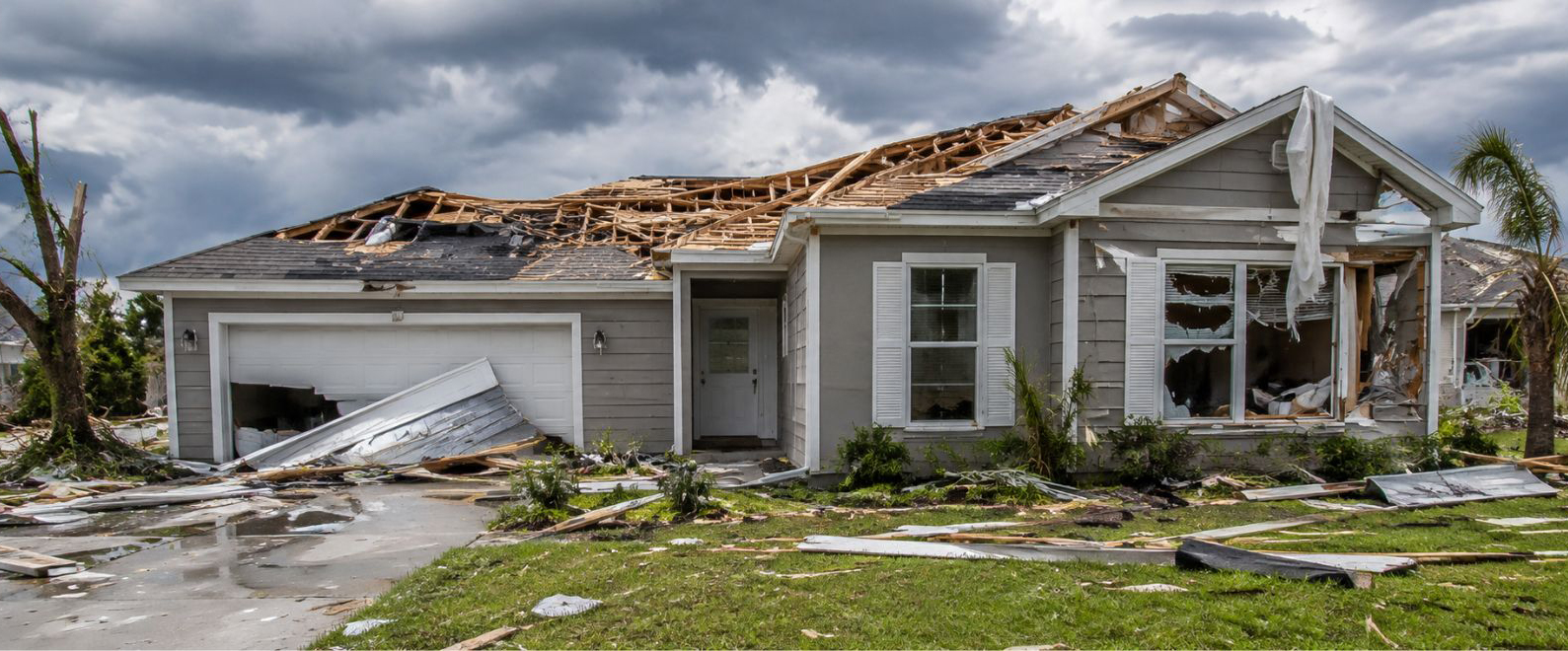
Imagine a tornado tears through your rental property, leaving the roof damaged, windows broken, and part of the home unsafe to occupy. As a landlord, you may suddenly be dealing with property repairs, lost rental income, and questions about your responsibilities to the tenant while the property is unsafe or uninhabitable. Trying to figure out what your landlord insurance covers can be confusing.
A tornado can leave a rental property with several types of losses. Coverage depends on the policy language, endorsements, deductibles, limits, and cause of damage. Landlord insurance generally provides coverage for the building and landlord-owned property, while a tenant’s renters insurance generally covers their belongings and loss of use, subject to policy terms.
This guide explains what a claim for tornado damage to a rental property may involve, what coverage to examine, and how Louisiana and Texas rules can affect recovery.
What Can a Landlord Recover After Tornado Damage?
A tornado can leave a rental property with much more than a damaged roof. Depending on the policy, a landlord may be dealing with structural repairs, damage to detached structures and landlord-owned contents, building-code requirements, lost rental income, and expenses incurred to protect the property. Identifying each category matters because a tornado can affect several types of property and financial losses.
Building and Structural Damage
Covered structural losses may include damage to the:
- Roof, walls, ceilings, floors, windows, and doors
- Cabinets, built-ins, plumbing, and electrical components
- HVAC systems and other permanently installed equipment
- Portions of the property requiring demolition and reconstruction
If repairs must bring a damaged portion of an older property into compliance with current building requirements, ordinance or law coverage may address some additional work when the policy or endorsement provides it. That coverage is not automatic. The actual recovery depends on what the policy defines as covered property, along with its exclusions, limits, deductibles, and valuation provisions.
Detached Structures and Exterior Property
A tornado may also damage a detached garage, shed, fence, outbuilding, or walkway. Fallen trees can create additional property damage and removal issues, with coverage depending on the policy.
Many policies treat detached property under other structures coverage. This coverage has its own terms and limits, so landlords should not assume that every exterior loss receives the same coverage as the main building.
Landlord-Owned Personal Property and Appliances
Landlord-owned items provided with the rental may also be covered when the policy includes them. Examples include refrigerators, stoves, washers and dryers, water heaters, lawn equipment, maintenance tools, and furnishings in a furnished rental.
These items should be distinguished from tenant-owned belongings. A landlord’s policy generally protects the building and the landlord’s property, while a tenant’s renters insurance generally addresses the tenant’s personal property.
Ordinance or Law / Building-Code Costs
Tornado repairs can trigger current building-code requirements, particularly when an older roof, electrical system, or structural component needs substantial reconstruction. Depending on the policy, ordinance or law coverage may help address certain additional requirements.
Matching can also become relevant if replacement materials cannot reasonably match undamaged portions. However, landlords should not assume that code upgrades or matching expenses are covered. The applicable endorsement, limits, exclusions, and policy language determine whether those expenses qualify.
Lost Rental Income / Loss of Rents
Physical damage may also interrupt the income a landlord relies on from the property. If covered tornado damage makes a rental uninhabitable, rent may be lost while the property is being repaired.
Depending on the policy, look for Loss of Rents, Rental Value, Business Income, or similar coverage. Not every landlord policy includes this protection. The policy may also specify a coverage limit, waiting period, and covered period, and may address whether certain continuing expenses qualify.
Landlords should preserve leases, rent records, bank statements, tax records, and other documentation that can establish the property’s rental income and the effect of the covered loss.
Additional Expenses
A damaged property may require immediate measures to prevent further loss or protect the premises. Depending on the policy, potentially covered expenses can include emergency security, temporary utilities or equipment, generator use, and emergency boarding or tarping.
Other reasonable expenses may also qualify when they are necessary to protect covered property or continue operations, but coverage remains policy-specific. Keeping receipts and documenting why an emergency expense was necessary can help establish its connection to the covered loss.
For landlords, documenting each category of damage and loss can make it easier to evaluate the claim against the applicable policy provisions.
Does Landlord Insurance Cover Tornado Damage?
Whether a rental property is covered after a tornado depends on how the policy addresses windstorm, flood, deductibles, valuation, and other applicable provisions.

Tornado and Windstorm Coverage
Tornado damage is generally treated as windstorm damage. Whether the resulting loss is covered depends on the policy’s terms, exclusions, and endorsements. A rental property should generally have an appropriate landlord or rental-property policy rather than a standard homeowners policy.
Wind and hail coverage can be structured differently in coastal Texas. The Texas Department of Insurance notes that coastal properties may need separate wind and hail coverage, including coverage through the Texas Windstorm Insurance Association in eligible circumstances.
Flood Damage Is Different
Wind damage and flood damage should not be treated as the same loss. Flood, surface water, and storm surge are generally excluded from standard property policies. Separate flood insurance may be available through the National Flood Insurance Program (NFIP) or a private insurer.
This distinction can become important when a tornado produces both wind and water damage. The cause and circumstances of each loss may affect which policy responds.
Deductibles
The applicable deductible can depend on the type of loss and the policy. A landlord may have a standard deductible as well as a separate wind, hail or named-storm deductible. Some policies use a percentage-based deductible rather than a fixed dollar amount.
There is no universal Louisiana or Texas deductible for tornado damage. The landlord should check the declarations page and applicable endorsements to determine which deductible applies.
Replacement Cost vs. Actual Cash Value
The policy’s valuation method can also affect a covered loss. Replacement Cost Value (RCV) generally reflects the amount required to repair or replace covered property without deducting depreciation, subject to the policy’s applicable terms and conditions. Actual Cash Value (ACV) takes depreciation into account when determining the value of the covered property.
Some policies may initially pay ACV and provide additional replacement-cost amounts after qualifying repairs. Others may apply different valuation provisions to certain property. Landlords should not assume that every rental-property policy provides replacement-cost coverage for the building, roof, contents, or other property.
Policy Limits and Endorsements
The declarations page provides a starting point, but landlords should also review the full policy and applicable endorsements. Pay particular attention to coverage for:
- Loss of rents or business income, including any conditions that apply
- Ordinance or law coverage for certain code-related requirements
- Other structures coverage for detached property
- Contents coverage for landlord-owned property
- Wind or windstorm coverage
- Flood coverage, whether provided separately or through another policy
Who Is Responsible for the Tenant’s Belongings and Temporary Housing?
After a tornado, landlords and tenants generally have different insurance responsibilities. The landlord’s policy typically addresses the building and landlord-owned property, while the tenant’s renters insurance generally covers personal belongings such as furniture, clothing, and electronics. A tenant’s loss-of-use coverage may also help with temporary housing when the rental cannot be occupied.
Landlords should communicate clearly with tenants about what they need to address through their own insurance while the landlord handles property-related responsibilities. Insurance coverage, however, does not replace a landlord’s obligations under the lease or applicable state law. In Louisiana, landlords generally must make necessary repairs to keep the property suitable for its leased purpose. Texas law similarly establishes repair obligations for conditions that materially affect a tenant’s physical health or safety, subject to statutory requirements and exceptions.
These obligations can become especially important when tornado damage makes the property unsafe or limits the tenant’s ability to use it.
Landlord’s Guide to Filing a Tornado Insurance Claim for a Rental Property
A tornado can leave a landlord with a damaged property, disrupted rental income, and a complicated insurance claim. Taking a methodical approach from the outset can help preserve evidence and make it easier to identify what the policy may cover.
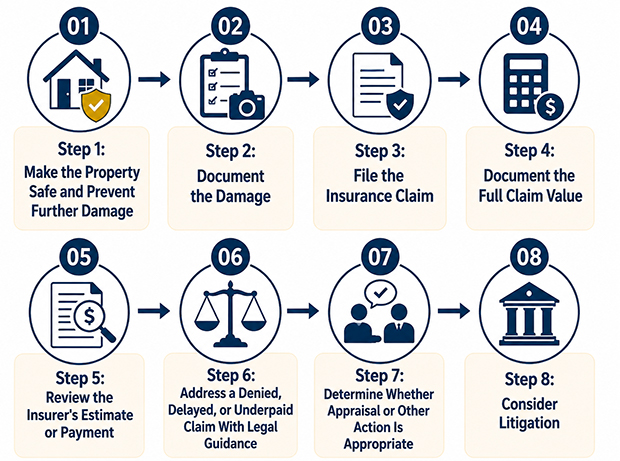
Step 1: Make the Property Safe and Prevent Further Damage
Safety comes first. Address hazards such as exposed wiring, unstable structures, broken glass, or roof openings before inspecting the property closely. Make reasonable temporary repairs, such as tarping a damaged roof, covering exposed areas, or boarding broken windows, to prevent additional damage. Document these measures and keep receipts for emergency repairs.
Do not make permanent repairs before the insurer has an opportunity to inspect the damage, unless immediate circumstances require otherwise.
Step 2: Document the Damage
Photograph and record video of the property before cleaning up or moving damaged items where it is safe to do so. Capture both close-up and wider views of:
- The roof and exterior structure
- Interior rooms and building systems
- Landlord-owned contents and appliances
- Detached structures, fences, and landscaping
Keep contractor reports, receipts, repair records, and photographs showing the property’s condition before the tornado.
Step 3: File the Insurance Claim
Notify the insurer promptly and follow the policy’s notice requirements. Have the policy number and an initial assessment available if possible. Ask for the claim number and the adjuster’s contact information, and keep a written record of communications.
The insurer may request additional information during its investigation. Responding promptly and keeping copies of what you provide can help maintain a clear record of the claim.
Step 4: Document the Full Claim Value
Do not limit your documentation to visible structural damage. Obtain detailed repair estimates addressing all affected portions of the property and applicable covered expenses.
For lost rental income, preserve leases, rent records, bank statements, tax records, and repair timelines. Keeping 1–2 years of rental-income records, where available, can provide useful historical context when establishing the property’s normal rental activity.
Step 5: Review the Insurer’s Estimate or Payment
Compare the insurer’s estimate against your documented damage and repair information. Look for potentially omitted items, depreciation, code-related work, detached structures, landlord-owned contents, and applicable lost-rent coverage.
Check whether the insurer’s estimate accounts for all covered damage and applies the valuation provisions in the policy.
Step 6: Address a Denied, Delayed, or Underpaid Claim With Legal Guidance
If the claim does not appear to reflect the covered loss, identify what type of dispute exists:
- Denied: Review the written denial and the policy provision the insurer cites.
- Delayed: Keep records of communications and any applicable claim deadlines.
- Underpaid: Compare the insurer’s estimate against the documented damage, depreciation, and applicable coverage.
At this stage, discussing the claim with a property damage attorney can help you understand the policy, the insurer’s position, and available options.
Step 7: Determine Whether Appraisal or Other Action Is Appropriate
Appraisal may be worth evaluating when the primary dispute concerns the amount of loss rather than whether the policy provides coverage. It generally addresses valuation rather than resolving broader coverage questions.
If the dispute involves coverage, bad faith, or another legal issue, an attorney can help determine whether appraisal is appropriate or whether another course of action makes more sense.
Step 8: Consider Litigation
If the dispute cannot be resolved through the available claim process or appraisal, litigation may be an option to evaluate. An attorney can review the policy, supporting evidence, insurer’s position, and applicable deadlines before determining whether legal action is appropriate.
The applicable deadlines can differ between Louisiana and Texas, and certain statutory deadlines may have extensions in qualifying catastrophic circumstances.
Louisiana vs. Texas: Rules Landlords Should Know
Louisiana and Texas impose different requirements on landlords and insurers after property damage. The key rules and deadlines can affect both the rental property and an insurance claim.
Louisiana Rental Property Tornado Damage
Louisiana Civil Code art. 2691 generally requires landlords to make necessary repairs to keep leased property suitable for its intended use. Articles 2714 and 2715 address the effect of total or partial destruction on a lease, including potential termination or rent reduction depending on the circumstances.
For covered insurance claims, La. R.S. 22:1892 generally requires payment within 30 days after satisfactory proof of loss. For catastrophic losses, insurers generally have 30 days to initiate adjustment, and additional time may apply following a qualifying presidentially or gubernatorially declared emergency or disaster. Louisiana law also provides at least 180 days to submit proof of loss for qualifying catastrophic events.
Tornado and wind coverage should also be distinguished from separate flood insurance. Landlords can contact the Louisiana Department of Insurance regarding insurance complaints.
Texas Rental Property Tornado Damage
Texas Property Code §92.054 addresses casualty losses and may allow termination when a dwelling becomes totally unusable.
Under Texas Insurance Code Chapter 542, insurers generally have 15 days to acknowledge a claim and begin investigating, then 15 business days after receiving the required information to accept or reject the claim. An insurer may obtain an additional 45 days when it provides the required explanation. Once payment is agreed, it is generally due within 5 business days. Statutory deadlines may be extended by 15 days following a weather-related catastrophe or major natural disaster.
Texas generally provides a two-year limitations period for certain property-damage litigation, while applicable claims may also require 61 days’ pre-suit notice under Chapter 542A. These requirements can vary by claim, so landlords should verify which provisions apply. The Texas Department of Insurance can also assist with insurance complaints.
Can Landlords Get FEMA or SBA Disaster Assistance?
Insurance is generally the first source to examine after tornado damage, but federal disaster programs may provide additional options when a qualifying disaster is declared. FEMA assistance and SBA disaster loans are separate programs with different eligibility requirements.
FEMA Assistance
FEMA assistance depends on a federal disaster declaration, the specific assistance programs activated, and the applicant’s eligibility. FEMA assistance is not an insurance payout and is generally intended to address eligible disaster-related needs that are not adequately covered by insurance.
Landlords should not assume that assistance available to an owner-occupied home also applies to an investment or rental property. FEMA’s individual assistance programs primarily address eligible individuals and households, while rental-property recovery may involve other federal, state, or local programs. Eligibility should therefore be confirmed for the specific property and disaster.
SBA Disaster Loans
SBA disaster loans are loans, not insurance settlements or grants. They may be available after a qualifying disaster declaration to eligible businesses and can help address disaster-related physical damage that insurance or other sources do not fully cover. SBA specifically notes that qualified rental properties may be eligible through its business physical disaster loan program.
A landlord may need to establish that the rental activity qualifies as an eligible business under the applicable SBA requirements. Insurance proceeds can also affect the amount of SBA assistance available.
These programs should not be treated as guaranteed compensation for an insured loss. A landlord should first determine what the insurance policy covers, then assess whether FEMA assistance or an SBA disaster loan is available for any remaining eligible needs.
How Can Attorneys Help Landlords with Tornado Damage Claims?

When a tornado claim becomes complicated, a property damage attorney can help a landlord understand whether the insurer’s position is consistent with the policy. The process typically starts with reviewing the policy, endorsements, exclusions, and valuation provisions alongside the insurer’s estimate and coverage determination.
That review can reveal potentially omitted covered losses, disputed damage, or disagreements over depreciation and other valuation issues. If the insurer denies, delays, or underpays the claim, an attorney can assess the reasons given and communicate with the insurer to pursue an appropriate resolution.
Where the dispute concerns the amount of loss, an attorney can also evaluate whether appraisal is appropriate. If the matter involves broader coverage or statutory issues, the attorney can assess potential remedies and determine whether litigation is warranted.
The goal is to help landlords understand their insurance recovery options and pursue the benefits potentially available under their policy, rather than manage the property’s repairs or tenant relationships.
Conclusion
After a tornado, landlords should look beyond visible structural damage and account for covered property, lost rental income, code-related requirements, and necessary emergency measures. The applicable policy and state law will determine which losses and remedies may be available.
It is also important to distinguish wind damage from flood, which generally requires separate coverage. Depending on the disaster and eligibility, FEMA assistance or an SBA disaster loan may provide additional options, but neither replaces an insurance claim.
If an insurer denies, delays, or underpays a claim, landlords can consider the available escalation options, including reviewing the insurer’s decision, filing a complaint with the appropriate state insurance department, evaluating an appraisal for an amount-of-loss dispute, or discussing potential legal action with a property damage attorney. A careful review of the policy and supporting evidence can help determine the appropriate next step.