
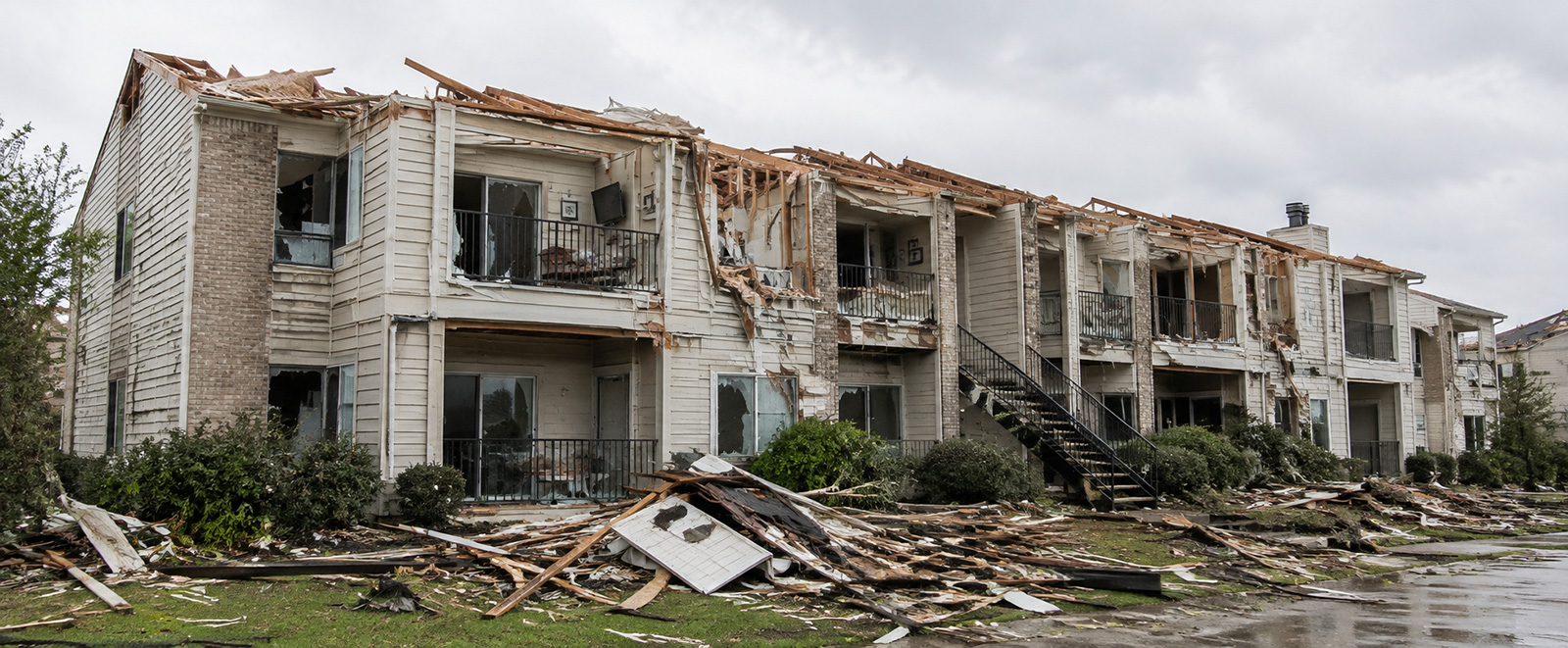
A tornado can leave your condo damaged in minutes, leaving you with a long list of questions. Should you contact your insurance company, the condo association, or both? The answer often depends on what the storm damaged and how your condominium’s insurance is structured.
After a tornado, two policies may come into play: your individual condo insurance policy, often called an HO-6 policy, and the association’s master policy. Understanding which policy may cover a particular loss can be challenging. This guide explains what to do after a tornado, how condo insurance may apply to different types of damage, how to document and file your claim, and what to do if the insurer or association disputes coverage.
Your Condo Was Damaged by a Tornado. What Should You Do First?
Once the immediate danger has passed, focus on protecting yourself, documenting the loss, and notifying the parties that may be involved in the insurance process.
- Make sure the building is safe before re-entering. Follow instructions from local authorities or building management, especially if the tornado caused structural or electrical damage.
- Photograph and video the damage. When it is safe to do so, document the condition of your condo before cleanup or repairs begin.
- Organize the damage by category. Keep separate records of damage inside your unit, personal belongings, and visible exterior or common-area damage.
- Take reasonable steps to prevent additional damage. Temporary measures, such as covering a broken window or exposed opening, may help protect the property until permanent repairs can begin.
- Notify your HO-6 insurer. Report the loss and ask what documentation your insurer requires.
- Notify the condo association, HOA, or property manager. Tornado damage may affect parts of the property that fall under the association’s responsibility.
- Ask how the association is handling damage covered by its master policy. Find out whether the association has reported the building damage and how it plans to coordinate inspections and repairs.
- Keep your receipts. Save documentation for temporary repairs and additional living expenses if you cannot safely remain in your condo.
- Do not discard damaged property unless necessary for safety or mitigation. Do not throw items away before photographing and documenting them unless removal is necessary for safety or to prevent further damage.
Do not assume you need to wait for the HOA before contacting your own insurer. Because tornado damage can involve both individual and association coverage, notifying both parties can help clarify which policy may apply to each part of the loss.
Condo Insurance After a Tornado: Which Insurance Policy Covers Damage
Condo insurance after a tornado can be more complicated than a typical property claim because your unit and the larger condominium property may have separate insurance coverage. Your individual policy and the association’s master policy can each play a role.
Your Individual Condo Insurance Policy (HO-6)
An HO-6 policy is designed for condominium unit owners. Depending on its terms, coverage may include:
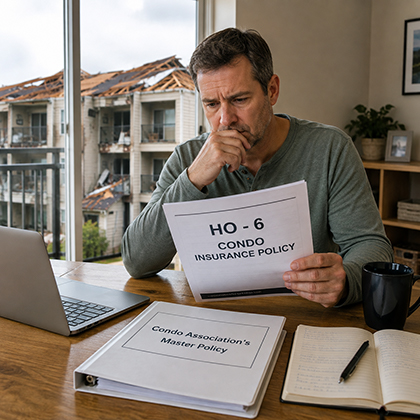
- Personal belongings damaged by a covered loss
- Interior portions of the unit that are the owner’s responsibility
- Improvements or alterations for which the owner is responsible
- Additional living expenses when a covered loss makes the unit uninhabitable
- Loss assessment coverage, when included and applicable
The exact protection depends on the language, limits, exclusions, and endorsements in your policy. Texas regulators, for example, describe condominium insurance as covering personal property, the unit’s interior, and additional living expenses.
The Condo Association’s Master Policy
The association’s master policy generally insures property for which the condominium association is responsible. The scope of that coverage varies according to the association’s policy and the condominium’s governing documents.
Master policies are sometimes described as bare walls, walls-in, or all-in/single entity, depending on how far the association’s building coverage extends into individual units. These labels can be useful starting points, but owners should rely on the actual policy and condominium documents rather than the label alone.
Ultimately, responsibility may depend on state law, the declaration and bylaws, the master policy, your HO-6 policy, and how each document defines the damaged property. That is why it is essential to determine which party and policy may be responsible for each portion of the loss.
How Do You Know Whether the Damage Is Your Responsibility or the HOA’s?
After a tornado, it is not always obvious whether you or the condo association should handle a damaged item. Responsibility generally depends on the condo declaration, bylaws, master policy, and defined unit boundaries, rather than simply where the damage occurred. Louisiana law, for example, addresses association insurance for common elements and units while excluding owner-installed improvements and betterments from that required coverage.
Your HO-6 policy may provide coverage for property that falls within your responsibility, including personal belongings and certain improvements. Betterments and improvements can include upgraded flooring, cabinetry, fixtures, or other changes that go beyond the property’s original construction.
Before deciding which policy to pursue, review:
- The condominium declaration and bylaws
- The master insurance policy and applicable coverage provisions
- Your HO-6 policy and endorsements
- Documents defining unit and common-element boundaries
These documents can help clarify who is responsible and which policy may respond to each portion of the tornado damage. If the documents and insurance policies appear to conflict, consider getting legal guidance before accepting a coverage position.
How to File a Tornado Damage Insurance Claim as a Condo Owner
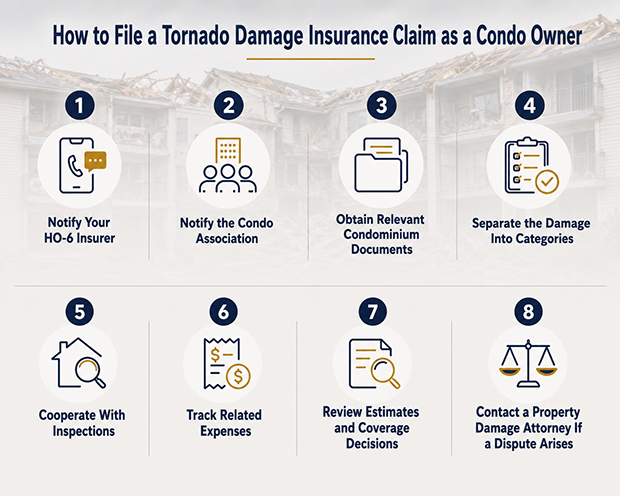
After a tornado, handling a condo insurance claim requires more than documenting the damage inside your unit. It requires organized documentation and coordination with the parties responsible for different portions of the property.
- Notify Your HO-6 Insurer: Report the tornado damage and provide available photographs, videos, and other initial documentation. Follow the insurer’s instructions for submitting supporting information.
- Notify the Condo Association: Tell the HOA or property manager about the damage and ask how it is addressing damage to the building and common elements.
- Obtain Relevant Condominium Documents: Request the declaration, bylaws, applicable insurance information, and provisions addressing repairs, maintenance, and responsibility for different portions of the property.
- Separate the Damage Into Categories: Keep records for:
- Building or common-area damage
- Damage within your unit
- Improvements and betterments
- Personal property
- Additional living expenses, when applicable under your policy
- Cooperate With Inspections: Make your property available for your individual insurer’s inspection. The association may also arrange its own inspection or use contractors to evaluate building or common-element damage.
- Track Related Expenses: Keep receipts and records for mitigation, emergency repairs, temporary housing, storage, and other expenses that may be covered under the applicable policy.
- Review Estimates and Coverage Decisions. Check what the estimates include and whether any damage was excluded, depreciated, or assigned to another policy. Do not assume that the first estimate or coverage decision accounts for every potentially covered loss.
- Contact a Property Damage Attorney If a Dispute Arises: If the insurer or HOA disputes responsibility, coverage, or the scope of repairs, an attorney can review the relevant policies and condominium documents and help you evaluate your options.
Keeping your documentation organized from the beginning can make it easier to identify which party and policy may be responsible for each part of the loss.
Louisiana Condo Owners: How the Coverage Rules Apply
Louisiana law provides a framework for condominium insurance, but it does not automatically determine which policy will pay for every tornado-related loss. La. R.S. 9:1123.112 generally requires a condominium association to maintain property insurance, to the extent reasonably available, covering common elements and units, while excluding owner-installed improvements and betterments from that required association coverage. The statute also addresses how unit-owner coverage for betterments and improvements interacts with association coverage.
For example, an upgraded floor, custom cabinetry, or higher-quality fixtures may qualify as a betterment or improvement under the statute. A unit owner’s policy is generally primary for those betterments and improvements to the extent of their value, while the association policy remains primary for common elements, structural elements, and certain unit components that do not qualify as betterments or improvements.
Your condominium declaration and bylaws also matter. Louisiana law requires the declaration to address reconstruction or repair after a casualty and the distribution of applicable insurance proceeds. The statute provides a framework, but the applicable condominium declaration, bylaws, master policy, and HO-6 policy still need to be considered together when evaluating a tornado damage claim.
Texas Condo Owners: How the Coverage Rules Apply
Texas law also establishes specific insurance requirements for condominium associations. Under Tex. Prop. Code §82.111, an association must maintain, to the extent reasonably available, property insurance covering insurable common elements against commonly insured risks. The statute also provides that when a condominium building contains units with horizontal boundaries described in the declaration, the association’s property insurance must, to the extent reasonably available, include the units. However, that required coverage does not have to include owner-installed improvements and betterments.
This distinction can matter for stacked or multi-story condos, where units are located above or below one another and the declaration establishes horizontal boundaries. An owner’s upgraded flooring, cabinetry, fixtures, or other improvements may therefore require separate consideration under the owner’s HO-6 policy.
Texas law also allows association policies to carry commercially reasonable deductibles determined by the board. Those deductibles, along with repair costs not covered by insurance, can create additional financial issues for unit owners. For that reason, the statutory requirements should be considered alongside the declaration and master policy when determining how tornado-related repairs and improvements may be handled.
What If Your HOA or Insurance Company Disputes Your Claim?
Condo insurance disputes can arise when the HOA and insurer disagree about who should cover damaged property, or when the insurer denies, delays, or underpays a claim. Other disagreements may involve owner-installed improvements, deductibles, loss assessments, or personal property. These disputes often stem from differences in how the declaration, master policy, and HO-6 policy define the same property or loss.
If a dispute develops, take a methodical approach:
- Identify the coverage dispute. Determine which damage is being disputed and why the insurer or HOA says it falls outside its responsibility.
- Gather supporting documents. Collect the claim correspondence, estimates, photographs, policy provisions, and condominium documents relevant to the disputed damage.
- Address the dispute. Ask the insurer or HOA to explain its coverage position and identify the policy provision supporting that decision.
- Contact a property damage attorney. An attorney can review the policies and condominium documents and help assess your options.
- Pursue the claim if necessary. If the dispute remains unresolved, legal counsel can help determine an appropriate course of action.
Resolving these questions can help clarify responsibility and prevent confusion from delaying necessary repairs or leaving you responsible for damage that another policy may cover.
How a Tornado Damage Lawyer Can Help Condo Owners?
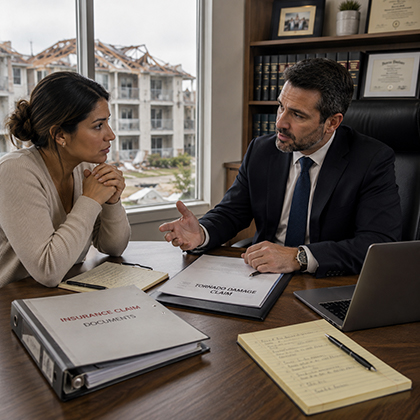
A tornado damage lawyer can help you make sense of a claim when your condo has sustained damage involving multiple insurance policies. A property damage attorney can review your HO-6 policy, the association’s master policy, condominium declaration, bylaws, and claim records to help identify potentially covered damage and determine where coverage responsibilities may fall.
Legal guidance can also be useful when an insurer or HOA disputes responsibility, particularly when the disagreement involves improvements and betterments, personal property, deductibles, or the scope of repairs. An attorney can help you understand the insurer’s position, organize relevant documentation, communicate regarding the dispute, and evaluate available options for pursuing benefits under the applicable policy.
The goal is to help protect your legal and contractual rights while navigating a complicated claim. Because every condominium and insurance policy is different, the appropriate approach depends on the specific facts and documents involved.
Conclusion
Tornado damage can create complicated insurance questions for condo owners, particularly when both an HO-6 policy and an association’s master policy may apply. Document the damage carefully, preserve relevant receipts and records, and review your condominium documents and insurance policies to understand which coverage may apply.
If your insurer or HOA disputes responsibility, coverage, or the scope of repairs, legal guidance can help you understand your options and protect your rights. Pandit Law can review the circumstances of your property damage claim and help you navigate an insurance dispute.
Contact Pandit Law today for a free case evaluation.