
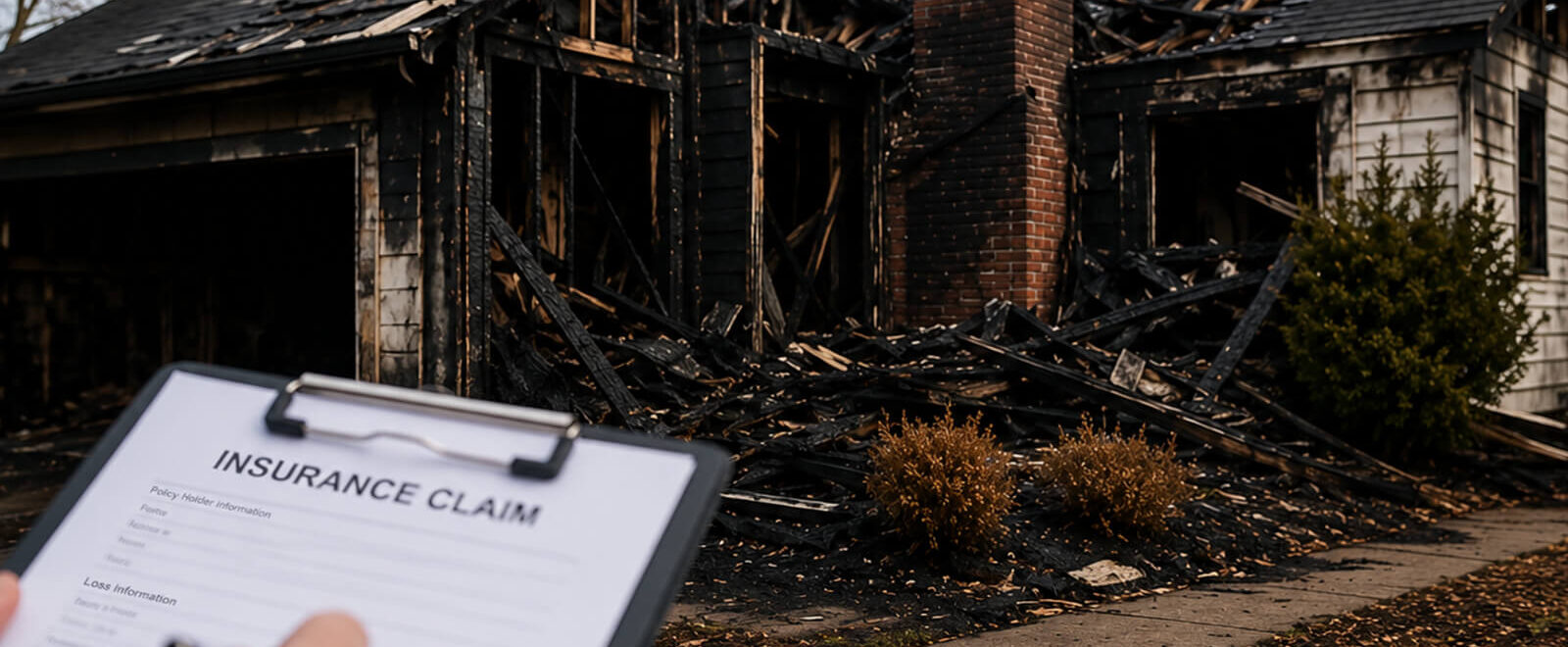
A fire can change everything in a matter of minutes. When flames leave a home or business beyond repair, insurers may classify the damage as a total loss by fire, triggering a very different claims process than minor or repairable damage. Beyond the obvious emotional toll, property owners often face immediate financial pressure, housing uncertainty, and difficult insurance decisions.
Understanding how fire insurance works and what the law requires can make a meaningful difference during this period. Because insurance rules are not the same everywhere, this guide focuses on how Texas and Louisiana handle total loss fire claims and what property owners should know before dealing with insurers.
What is a Total Loss Fire Claim?
A total loss fire occurs when a property is so severely damaged by fire that repairing it no longer makes economic sense. A total loss fire claim is the insurance request filed to recover benefits when that level of destruction occurs. Insurers typically determine total loss status by comparing repair costs to the property’s pre-fire value.
Key policy terms that often shape the outcome include:
- Actual Cash Value (ACV) reflects depreciation at the time of loss.
- Replacement cost covers rebuilding without deducting for age or wear, up to policy limits.
- Deductibles reduce the final payout amount.
Unlike partial losses, total losses may qualify for payment of full dwelling limits under state law.
Understanding Fire Insurance Policies and Total Loss Clauses

Fire insurance policies do more than confirm coverage. They set the rules for how insurers evaluate damage and decide whether a loss qualifies as total. In a fire loss insurance claim, the insurer typically compares the cost to repair the structure against its value before the fire. If rebuilding costs exceed that value, the property may meet the policy’s definition of a total loss.
Most policies divide coverage into distinct categories:
- Dwelling coverage applies to the structure itself, including walls, roofs, and permanently attached features.
- Personal property coverage applies to belongings inside the home or business and often carries separate limits.
How much a policy pays also depends on the valuation method:
- Replacement cost pays to rebuild or replace the structure without subtracting depreciation, subject to policy limits.
- Actual Cash Value (ACV) accounts for age and wear, which can significantly reduce payouts.
Additional Living Expenses (ALE) can also play a critical role after a total loss fire. ALE may reimburse reasonable costs for temporary housing, meals, and other necessities while the property remains uninhabitable.
At the same time, understanding policy exclusions and limits also matters. Common examples include flood-related damage, certain acts of negligence, or capped payouts for specific categories of property. Reviewing these provisions early helps avoid surprises later in the claims process.
Key Steps in Filing a Total Loss Fire Claim
Filing a total loss fire claim involves more than notifying the insurer. Each step you take builds the foundation for how the claim is evaluated and paid.
When filing a total loss fire claim:
- Contact the insurance company immediately. Prompt notice starts the claims process and preserves your rights under the policy.
- Document the damage thoroughly. Take photos and videos of the structure and create detailed inventories of personal property lost in the fire.
- Submit proof of loss. This formal statement outlines the extent of damage, estimated value, and supporting documentation required by the insurer.
- Request additional living expenses. If the property is unlivable, ask about ALE benefits as soon as possible.
- Obtain repair and replacement estimates. Independent estimates help clarify whether rebuilding is economically feasible.
- Review the settlement offer carefully. Compare it against policy limits and coverage terms.
- Negotiate if necessary. Disputes often arise over valuation or total loss classification.
Contact a lawyer when issues arise. Legal guidance can help if the claim is delayed, underpaid, or improperly denied.
State-Specific Rules: Total Loss Fire Claims in Texas and Louisiana
State law plays a major role in how insurers evaluate and pay a fire loss insurance claim, especially when a property is declared a total loss. Texas and Louisiana take different legal approaches, which can directly affect payout amounts, timelines, and disputes.
Texas: Total Loss Fire Claims
Texas law includes strong protections for property owners when a fire causes a total loss. Under Texas Insurance Code § 862.053, a fire insurance policy is considered a liquidated demand for the full amount of the policy limits if the property is a total loss. This rule generally applies to the dwelling itself, while personal property and ALE are governed by separate policy terms.
Courts in Texas rely on the “Reasonably Prudent Owner” test to determine total loss status. A property qualifies as a total loss if a reasonable owner would not rebuild because repairs are no longer economically practical. Additionally, a “Constructive Total Loss” may occur if local ordinances or building codes prohibit the repair of a partially damaged structure, forcing a total demolition.
Disputes often arise when insurers:
- Undervalue structural damage to avoid the “liquidated demand” threshold.
- Argue that the property is repairable despite local code prohibitions.
- Delay or dispute total-loss classification, which may affect exposure to statutory interest and penalties under Tex. Ins. Code Chapter 542.
Louisiana: Total Loss Fire Claims
Louisiana follows the Valued Policy Law (VPL) under La. R.S. § 22:1318. When a covered fire causes a total loss, insurers must pay the policy’s stated value, regardless of actual rebuilding costs. In Louisiana, courts often use the “Restoration Test,” comparing repair costs to the property’s pre-loss value to determine if restoration is physically or economically feasible.
Beyond valuation, La. R.S. § 22:1311 prescribes the Louisiana Standard Fire Policy, a mandatory “legal floor” for all fire contracts.
Louisiana law also mandates standard fire policy provisions and strict payment deadlines. Under La. R.S. § 22:1892, insurers must pay claims within 30 days of receiving satisfactory proof of loss (or 60 days for catastrophic declarations). However, 2024 legislative updates now require policyholders in certain catastrophic claims to provide a 60-day “Cure Period Notice” before filing suit, giving insurers a final window to settle the undisputed amount before certain statutory penalties may be pursued.
Thorough documentation and proof of loss submissions are critical, as timely and complete paperwork is often the legal trigger for these mandatory payment obligations under state law.
When Is a Home Considered a Total Loss Beyond Fire Damage?
A home can qualify as a total loss even when fire is not the cause. Severe damage from hurricanes, floods, tornadoes, vandalism, or accidents, such as a vehicle striking the structure, may render a property beyond economic repair. In these cases, insurers evaluate whether rebuilding costs exceed the property’s value before the loss.
Coverage depends heavily on the type of event. Fire policies usually do not cover flood damage, which often requires separate flood insurance. Storm or wind damage may fall under homeowners policies but with different limits, deductibles, or exclusions than fire losses.
State law still matters. In Louisiana, flood-prone regions face stricter documentation standards, particularly after hurricanes. Texas policies may offer broader storm coverage but leave more room for dispute over whether damage qualifies as a total loss. Understanding how non-fire claims are evaluated helps property owners avoid coverage gaps and delays.
Common Disputes in Total Loss Fire Claims

Disputes are common in fire loss insurance claims, especially when insurers question whether damage qualifies as a total loss. Underpayment remains a frequent issue. Insurers may classify the damage as partial to reduce payout obligations or rely on depreciated values that do not reflect real rebuilding costs.
Another common disagreement involves whether the property should be repaired or rebuilt. Insurers sometimes argue that repairs are possible, even when costs approach or exceed the property’s pre-fire value. These disagreements can significantly affect settlement amounts.
Bad faith concerns may arise when insurers delay investigations, ignore documentation, or fail to follow state-mandated timelines. Policyholders should also watch deadlines closely. Proof of loss forms and insurer response periods differ by state.
State-specific issues can add further complexity as Louisiana policyholders may face longer settlement timelines due to strict documentation requirements under the Valued Policy Law. On the other hand, Texas policyholders often encounter more valuation disputes because total loss determinations rely on economic feasibility rather than fixed policy values.
How to Get the Most Out of Total Loss Claims
Property owners can protect their recovery by taking practical, proactive steps:
- Document everything thoroughly, clear photos, videos, and inventories support valuation.
- Understand your insurance policy, know limits, exclusions, and valuation methods.
- Obtain multiple repair or rebuild estimates; independent figures strengthen your position.
- Act quickly and file promptly; delays can complicate coverage and deadlines.
- Maintain clear communication with your insurer and keep records of all interactions.
- Know your state laws and rights; Texas and Louisiana apply different total loss rules.
How a Lawyer Can Help with Total Loss Fire
Legal guidance can make a meaningful difference after a total loss fire, especially when insurers dispute coverage or valuation. An experienced lawyer can help you with:
- Initial Claim Evaluation: An attorney can review the policy, damage assessment, and insurer conduct to determine whether the claim is being handled fairly and in line with state law.
- Settlement Negotiation: They can challenge improper total loss classifications, low valuations, or reduced settlement offers and push for accurate application of policy limits.
- State-Specific Compliance: Because Texas and Louisiana apply different legal standards to total loss claims, an attorney helps ensure the insurer follows the correct state laws and regulations.
- Bad Faith Assessment: Legal counsel can identify unreasonable delays, unjustified denials, or other conduct that may violate insurance laws.
Court Representation (If Needed): If negotiations fail, a lawyer can handle litigation and represent the property owner in court, allowing the client to focus on rebuilding and recovery.
Conclusion
A total loss fire claim involves more than property damage. It triggers complex insurance rules, strict documentation requirements, and state-specific legal standards. Texas and Louisiana approach total loss claims differently, which can directly impact payouts and timelines. Understanding these differences and knowing when disputes may arise helps property owners protect their rights. Legal guidance can provide clarity, accountability, and support throughout the claims process.
If you are navigating a total loss fire claim, consider reaching out to Pandit Law for a free claim evaluation to better understand your options and next steps.
Frequently Asked Questions
A home is usually considered a total loss when fire damage makes repairs economically impractical. Insurers compare the cost to repair the structure with its value before the fire. If rebuilding costs exceed that value, the home may qualify as a total loss under the policy and state law.
The claim value depends on policy terms and state law. Some policies pay replacement cost, while others pay actual cash value after depreciation. In certain situations, state laws may require insurers to pay full dwelling limits when a covered fire causes a total loss.
If your house is declared a total loss, the insurer evaluates coverage limits, valuation method, and documentation before issuing payment. You may also qualify for additional living expenses if the home is uninhabitable. Disputes can arise over valuation, timing, or total loss classification.
In many cases, insurers expect policyholders to keep coverage active until the claim resolves. Cancelling too early can complicate payouts or future disputes. Reviewing the policy and speaking with a lawyer can help business owners avoid unintended coverage issues during the claims process.
An insurer may dispute the loss value, argue depreciation applies, or claim the damage is only partial. However, state laws and policy terms limit when full payment can be denied. If delays or underpayment occur, legal guidance may help address improper claim handling.
Partial fire damage follows a different claims process. Instead of paying policy limits, insurers usually cover repair costs up to coverage limits. Disputes often involve repair scope, pricing, or depreciation. Partial losses do not usually trigger the same payment rules as total loss claims.
A total loss designation usually applies to the structure. Personal property and ALE are covered under separate policy sections with their own limits. Coverage depends on documentation, valuation method, and specific policy language, which may differ from dwelling coverage rules.