
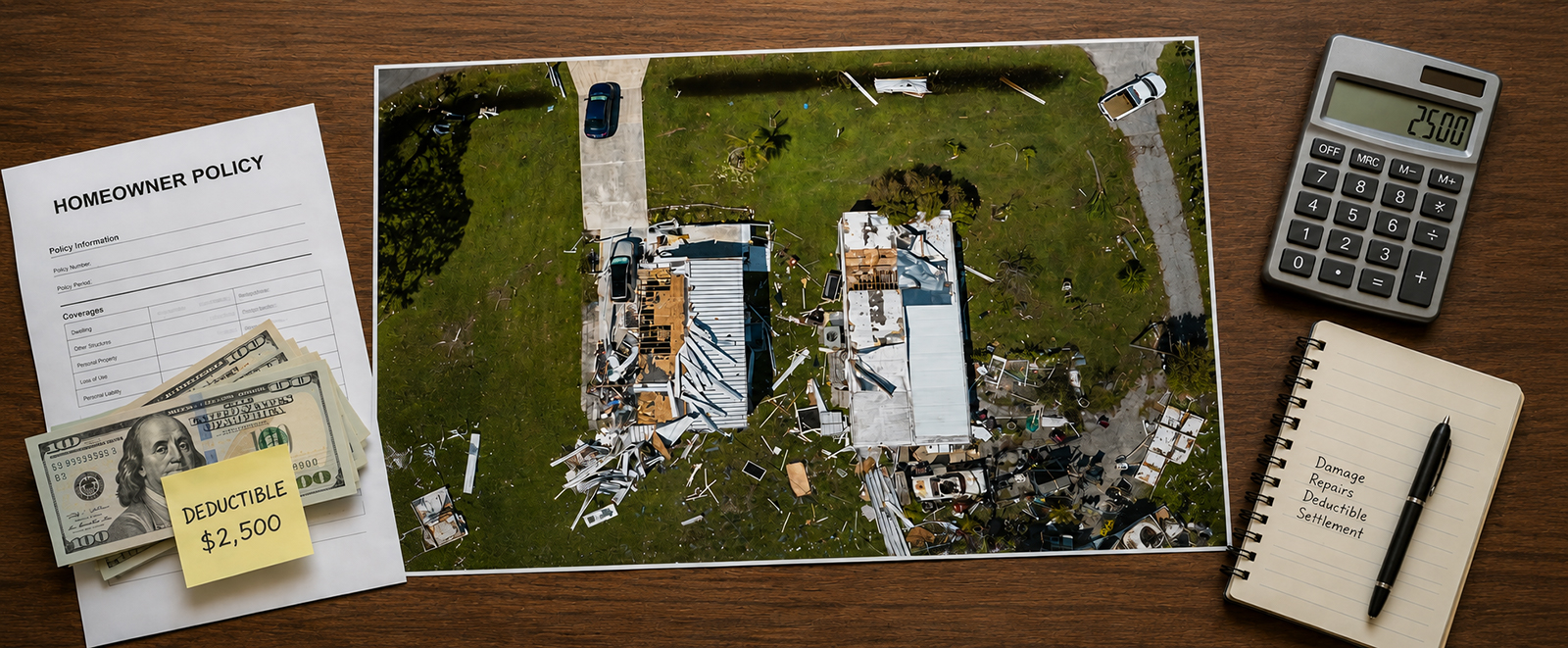
A hurricane damages your home, and you file a claim. Months later, another qualifying storm hits. When you review the second claim, you may wonder: Do I have to pay my full hurricane deductible again? It is an understandable question, especially when storm-related insurance claims involve different deductibles and complicated policy language.
Louisiana law provides an important protection for qualifying homeowners policies. Under La. R.S. 22:1337, the Louisiana hurricane deductible law generally limits how a hurricane or named-storm deductible applies across qualifying losses during the same calendar year. That means a second qualifying storm does not automatically trigger another full hurricane deductible.
Understanding how the annual rule, remaining deductible, and standard deductible interact can help you make sense of your claim.
What Is a Hurricane or Named-Storm Deductible?
After a major storm, the deductible listed on your policy can make a substantial difference in what you pay out of pocket. Louisiana homeowners policies may have different deductibles depending on the cause of the loss:
- Hurricane or Named-Storm Deductible: Applies when covered damage results from a hurricane or qualifying named storm. These deductibles are commonly 2% to 5% of the dwelling coverage or insured property value.
- Standard or All-Perils Deductible: Generally applies to covered losses that do not trigger a separate storm deductible.
- Wind and Hail Deductible: May apply to certain wind or hail losses, depending on the policy.
For example, if the insured value used to calculate your policy’s hurricane deductible is $500,000 and the deductible is 2%, the deductible would be $10,000. That is why understanding which deductible applies is important before evaluating a storm claim.
What Does Louisiana’s One-Deductible-Per-Year Law Say?
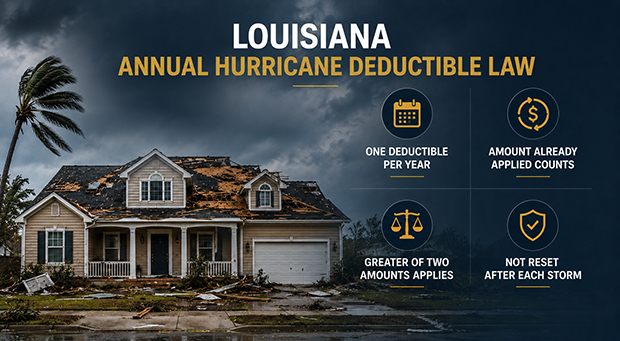
Louisiana’s law addresses an issue that can become especially important when multiple storms affect the same property in one year. Under La. R.S. 22:1337, qualifying homeowners policies issued or renewed on or after January 1, 2010, generally apply a separate hurricane or named-storm deductible on an annual basis to covered losses subject to that deductible during the calendar year.
In practical terms, the Louisiana hurricane deductible law generally means the full separate deductible does not simply reset after every qualifying storm. Instead, the amount already applied to an earlier qualifying loss can reduce the remaining deductible for a later loss.
For a later qualifying storm, Louisiana law allows the insurer to apply whichever is greater:
- The remaining amount of the separate hurricane or named-storm deductible
- The deductible that applies to other perils under the policy
This distinction matters because a later claim may still involve a deductible even though the annual storm deductible was not reset.
How the One-Deductible-Per-Year Rule Works in Louisiana
Consider a homeowner with a $500,000 insured property value and a 2% hurricane deductible, making the annual hurricane deductible $10,000.
Suppose the first qualifying storm causes $7,000 in covered damage. The $7,000 loss is applied toward the $10,000 annual hurricane deductible, leaving $3,000 remaining.
Because $7,000 was already applied to the annual deductible, $3,000 remains for a subsequent qualifying loss. However, the calculation does not necessarily mean the second claim has no deductible. For a later qualifying storm, Louisiana law allows the insurer to apply the greater of the remaining separate deductible or the deductible that applies to other perils under the policy.
Once the annual hurricane deductible has been fully satisfied, it generally does not reset for another qualifying hurricane or named-storm loss during that calendar year. The exact calculation still depends on the policy and the losses involved.
What Happens If the First Storm Fully Satisfies the Hurricane Deductible?
If the first qualifying storm produces enough covered damage to satisfy the entire annual hurricane deductible, no separate hurricane deductible remains for another qualifying storm during that calendar year.
For example, assume your policy has a $10,000 hurricane deductible. If a covered hurricane loss exceeds $10,000, the full annual hurricane deductible can be satisfied by that covered loss. If another qualifying hurricane or named storm occurs later in the same calendar year, the separate hurricane deductible generally does not reset to $10,000.
However, this does not necessarily mean the later claim has no deductible. Louisiana law provides that the applicable deductible for a subsequent loss can depend on the remaining separate deductible and the policy’s standard deductible. If the standard or all-perils deductible applies and is the greater amount, it may still be charged.
What If the Remaining Hurricane Deductible Is Less Than My Standard Deductible?
A remaining hurricane deductible does not always determine the amount you will see on a later claim. Louisiana’s law takes into account the deductible that would otherwise apply under the policy, which can make the higher deductible relevant to the calculation.
For example:
- Your original hurricane deductible was $10,000, and previous qualifying losses left $2,000 remaining
- Your policy has a $5,000 standard deductible
- Because the standard deductible is higher, the applicable deductible for the later claim may be $5,000
This can understandably look like the hurricane deductible was charged again. But the annual hurricane deductible has not necessarily been reset. Instead, the calculation may reflect the higher standard deductible applicable under the law and policy.
That distinction matters when reviewing an insurer’s estimate or payment statement. If the calculation does not appear consistent with your policy or prior storm claims, consider having the deductible calculation reviewed by a property damage attorney.
Hurricane vs. Named Storm vs. Windstorm Deductibles
Different storm-related deductibles may also apply depending on the event and the language of your homeowners policy. A hurricane or named-storm deductible should not automatically be treated as applicable to every wind-related loss.
| Deductible | When It May Apply |
| Hurricane Deductible | May apply to covered damage caused by a hurricane, as defined by the policy |
| Named-Storm Deductible | May apply when covered damage results from a qualifying named storm under the policy |
| Windstorm Deductible | May apply to certain covered wind-related losses, depending on the policy |
The definitions and triggering conditions can vary between policies, so the name of the deductible alone does not determine which one applies. Policy wording, the cause of loss, and the circumstances surrounding the storm all matter.
This is also important when applying Louisiana’s annual hurricane or named-storm deductible rule. The rule should not automatically be extended to an ordinary wind or hail claim that does not qualify under the policy as a hurricane or named-storm loss. Checking the declarations page and applicable policy provisions can help clarify which deductible the insurer used.
How Do I Know Which Deductible Applies to My Claim?
When a storm damages your property, the deductible applied to the claim should match the policy provisions and the circumstances of the loss. Because Louisiana policies can contain multiple deductibles, reviewing the relevant documents can help clarify the calculation.
Start by checking:
- Declarations Page: Look for the hurricane, named-storm, wind and hail, and standard deductibles listed for your policy.
- Storm Deductible Disclosure: Review the separate disclosure identifying applicable storm-related deductibles.
- Policy Wording: Check the definitions and conditions that explain when each deductible applies.
- Insurer’s Estimate or Payment Statement: Identify the deductible the insurer actually applied to the claim.
If you have already had a qualifying storm claim that year, compare the deductible charged on the later claim with the amount previously applied. Louisiana law generally requires qualifying separate hurricane or named-storm deductibles to be applied annually to covered losses subject to that deductible.
This comparison can help identify whether the calculation reflects the remaining deductible or another deductible required under the policy.
Do I Have to Pay the Hurricane Deductible Twice in One Year?
Generally, no. If Louisiana’s annual deductible rule applies, a qualifying hurricane or named-storm loss does not automatically trigger another full separate hurricane deductible later in the same calendar year. The amount already applied to an earlier qualifying loss is taken into account when determining the deductible for a subsequent loss.
However, a later claim may still involve a deductible. Louisiana law allows the applicable deductible to reflect the remaining separate deductible or the deductible that applies to other perils under the policy, whichever is greater.
That distinction is central to understanding the single hurricane deductible law. Seeing a deductible on a second storm claim does not necessarily mean the full hurricane deductible was charged again. The calculation depends on the prior loss, applicable deductibles, and policy terms.
What Should You Do If Your Insurance Company Charges the Full Deductible Again?

Seeing the full hurricane deductible on a second qualifying storm claim can be confusing, particularly if you already satisfied part or all of the annual deductible. Before concluding that the calculation is incorrect, review the policy and claim records carefully.
Consider these practical steps:
- Review the declarations page and storm deductible disclosure to confirm the applicable deductibles.
- Identify the deductible applied to the first qualifying storm claim and the amount of the covered loss that was applied toward it.
- Determine the remaining annual deductible, if any, based on the earlier claim.
- Review the insurer’s estimate and payment statement for the later storm to see which deductible was used.
- Ask the insurer for a written explanation of how it calculated the deductible on the later claim.
- Keep your claim records together, including estimates, correspondence, photographs, proof of loss, and payment records.
- Have the calculation reviewed if it still appears inconsistent with the policy or Louisiana law.
Louisiana law specifically permits insurers to consider the remaining separate deductible and the deductible applicable to other perils when calculating a later qualifying storm loss. A careful comparison of the policy, prior claim, and subsequent claim can help determine whether the deductible calculation warrants further review.
When Should You Talk to a Hurricane Insurance Claim Lawyer?
A storm claim can become more complicated when you are dealing with multiple losses, different deductibles, or a disagreement about what caused the damage. Consider speaking with a property damage attorney when questions about the claim go beyond simply understanding your policy.
Legal review may be helpful when you are dealing with:
- An apparent error in how a hurricane or named-storm deductible was calculated
- A denied or underpaid property damage claim
- A delayed claim or unresolved dispute with the insurer
- A disagreement about whether damage resulted from wind, a hurricane, or flood
- Questions about how multiple storm losses should be handled during the same calendar year
Pandit Law is a Louisiana property-damage law firm that represents policyholders in property damage insurance disputes. The firm can review the applicable policy provisions, claim estimates, deductible calculations, and communications from the insurer to assess the issues involved.
Conclusion
Louisiana’s one-deductible-per-year rule can make a significant difference when multiple qualifying hurricanes or named storms affect your property during the same calendar year. A second qualifying storm does not automatically trigger another full hurricane deductible. If you are unsure how your deductible was calculated, check your policy and claim records carefully.
For a denied, delayed, underpaid, or disputed hurricane claim, contact Pandit Law for a claim evaluation and legal guidance on your property damage insurance dispute.