

You filed a hurricane insurance claim, but the insurer still has not inspected the damage, made a coverage decision, or paid what you believe you are owed under your policy.
A delay can be frustrating, especially when you are trying to repair your property and move forward. However, a delayed hurricane insurance claim does not automatically mean the insurer acted in bad faith. The reason for the delay, stage of the claim, policy terms, and applicable state law all matter. Louisiana and Texas also have different rules for handling and paying claims.
This guide explains common causes of delays, relevant deadlines, when a delay may become improper, and how a property damage attorney can help you evaluate your options.
How Long Can an Insurance Company Take to Handle a Hurricane Claim?
There is no single deadline that applies to every hurricane insurance claim. How long an insurer can take depends on the state where the property is located, the type of loss, whether the event qualifies as a catastrophe, when the claim was reported, whether the insurer has received the information it reasonably needs, the policy terms, and any legally permitted extensions.
It also helps to separate the different stages of a claim. Acknowledging the claim is different from investigating the damage. An insurer may then request additional information before making a coverage decision. Once the insurer accepts the claim, a separate deadline may apply to payment.
Texas Hurricane Insurance Claim Deadlines
Texas Insurance Code Chapter 542, including Sections 542.055 through 542.058, establishes requirements for processing property insurance claims. Generally, the insurer must acknowledge the claim and request reasonably necessary information within 15 days. After receiving the information needed to evaluate the claim, the insurer generally has 15 business days to provide written notice accepting or rejecting the claim or explaining why additional time is needed. If the claim is approved, payment generally must be made within 5 business days after the approval notice.
The insurer may have additional time when the law permits an extension and provides the required notice explaining why more time is needed. For a weather-related catastrophe or major natural disaster, the Texas Department of Insurance may also extend applicable claim-handling deadlines by 15 days.
Louisiana Hurricane Insurance Claim Deadlines
Louisiana has different rules. Under La. R.S. 22:1892, an insurer generally must begin adjusting a property damage claim within 14 days after receiving notice of the loss. For a catastrophic loss, the period is generally 30 days, subject to certain extensions for declared emergencies or disasters. Payment generally follows receipt of satisfactory proof of loss.
For catastrophic losses involving residential property, La. R.S. 22:1892.2 generally provides a 60-day payment period after the insurer receives satisfactory written proof of loss. The rules can differ based on the nature of the property and the circumstances surrounding the catastrophe.
What Can Extend or Affect an Insurance Claim Deadline?
Several factors can affect how a claim progresses:
- The insurer may reasonably request additional information needed to investigate the loss
- A hurricane or other catastrophe may trigger special statutory extensions
- The policy may contain specific notice or proof-of-loss requirements
- Coverage or causation issues may require additional investigation
- State law may authorize an extension under particular circumstances
Importantly, an insurer’s request for additional information does not automatically erase or restart every applicable legal deadline. If your claim appears to be stalled, reviewing the claim history, policy, and applicable Louisiana or Texas deadlines can help determine whether the delay requires further action.
Why Is My Hurricane Insurance Claim Delayed?
A hurricane can generate a large number of insurance claims at once, and some delays have legitimate explanations. Insurers may need to coordinate inspections, review extensive damage, or investigate questions about coverage. But a legitimate reason for a delay should not be confused with an open-ended excuse for failing to handle a claim appropriately.
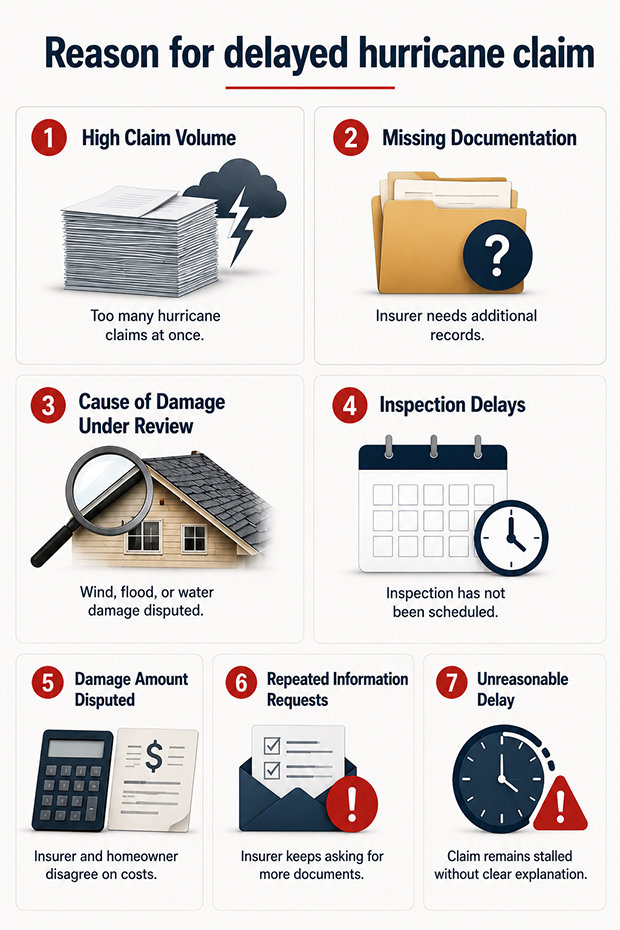
1. High Volume of Hurricane Claims
After a major storm, insurers may receive thousands of claims in a short period. That volume can affect inspection scheduling and claim processing. If the hurricane is declared a catastrophe, applicable law may extend certain claim-handling deadlines. However, those extensions are still subject to specific legal requirements and do not eliminate an insurer’s legal obligations to act within the applicable deadline.
2. The Insurer Needs More Documentation
An insurer may reasonably request photographs, repair estimates, receipts, proof of loss, or other information needed to evaluate the claim. The concern arises when requests become repetitive, unnecessary, or involve documents the insurer already received.
3. The Insurer Is Investigating the Cause
Hurricane damage can involve overlapping causes, including wind, flooding, storm surge, and water intrusion. An insurer may need to determine what caused particular damage and whether the policy covers it. Pre-existing damage can also become part of that investigation.
4. The Inspection Has Not Been Scheduled
An inspection may be necessary before the insurer can evaluate the damage. If appointments are repeatedly postponed or no inspection is scheduled despite repeated follow-up, keep records of those communications and missed appointments.
5. The Insurer Disputes the Damage Amount
The insurer and policyholder may disagree about the scope or value of covered damage. Differences can involve repair estimates, hidden damage, actual cash value versus replacement cost, or certain code-related repairs.
6. The Insurer Keeps Requesting More Information
Repeated requests can become concerning when you have already provided the requested records and the insurer does not clearly explain what remains outstanding. Keep copies of everything you submit and document when you submitted it.
7. The Delay May Be Unreasonable
A prolonged or unexplained delay deserves closer review, particularly when the insurer provides little meaningful communication or appears to move the claim forward without a clear reason. Still, delay alone does not establish bad faith. The claim history, policy, applicable law, and insurer’s conduct must be evaluated together.
When Does a Delayed Hurricane Claim Become Bad Faith?
Not every delayed hurricane insurance claim involves bad faith. The reason for the delay can matter more than the number of days that have passed. A complex investigation may require additional time, while an unexplained failure to investigate or respond appropriately may raise different legal concerns.
It is important to distinguish an ordinary claim delay from a claim-handling problem, a violation of a prompt-payment requirement, or conduct that may support a bad-faith claim. Louisiana and Texas apply different statutes and standards, so the same delay may have different legal implications depending on where the property is located.
Signs an Insurance Company May Be Unreasonably Delaying Your Claim
Warning signs that may warrant closer review include:
- The insurer repeatedly postpones an inspection without a clear explanation.
- The insurer repeatedly requests documents that have already been provided.
- The insurer provides little meaningful information about the claim’s status.
- The insurer fails to make a coverage decision when required.
- The insurer does not pay amounts that are due after the applicable requirements have been satisfied.
These signs do not, by themselves, establish bad faith. The specific facts and applicable state law must be reviewed before drawing that conclusion.
Louisiana Bad-Faith Rules for Delayed Hurricane Claims
Louisiana law requires insurers to adjust claims fairly and promptly and make reasonable efforts to settle claims. Under La. R.S. 22:1892, certain conduct involving an insurer’s failure to pay a claim after satisfactory proof of loss can have legal consequences when the failure is arbitrary, capricious, or without probable cause.
Catastrophic residential property claims are subject to specific rules under La. R.S. 22:1892.2. For qualifying catastrophic losses, the statute provides additional requirements and remedies related to claim handling and requires policyholders to provide written notice and a 60-day opportunity to cure before filing an action under that section.
Because the applicable rules can depend on the type of property, loss, and claim circumstances, a property damage attorney should review the policy, claim history, deadlines, and required notices before formal escalation.
Texas Bad-Faith and Unfair Claims-Handling Rules
Texas Insurance Code Chapters 541 and 542 address different aspects of insurance claims, including unfair settlement practices and prompt-payment requirements. Texas law prohibits certain unfair claim settlement practices, including failing to acknowledge relevant communications with reasonable promptness, failing to affirm or deny coverage within a reasonable time, and failing to conduct a reasonable investigation.
A potential prompt-payment violation is not automatically the same as a broader bad-faith claim. The legal theory, insurer conduct, claim status, and applicable deadlines must be considered together.
If your hurricane claim remains stalled without a clear explanation, an insurance claim attorney can review whether the delay appears consistent with the policy and applicable Louisiana or Texas law and help you determine what action may be appropriate.
What to Do If Your Hurricane Insurance Claim Is Delayed
If your hurricane insurance claim appears to be stalled, do not simply wait for the insurer to act. Start by creating a clear record of what has happened and reviewing whether the delay is consistent with your policy and applicable law.
Step 1: Document the Delay With Your Attorney in Mind
Create a timeline showing:
- When you reported the loss and received a claim number
- When inspections were scheduled, completed, postponed, or canceled
- What documents the insurer requested and when you provided them
- Your communications with the insurer and any responses you received
- Any payments, coverage decisions, or requests for additional information
Keep photographs, videos, repair estimates, correspondence, policy documents, and claim records in one place. A detailed record can make it easier for a property damage attorney to understand what happened and identify potential issues.
Step 2: Consult an Experienced Insurance Attorney
Consider legal review if the insurer continues delaying the claim, disputes coverage, makes only a partial payment, denies the claim, or appears to have missed an applicable deadline. An insurance claim attorney can review the circumstances of the delay, assess potential coverage or claim-handling issues, and explain what legal options may be available.
Step 3: Follow Up With the Insurer in Writing
If appropriate, request a written update identifying what remains outstanding and where the claim stands. Written communication can create a clearer record than relying entirely on phone conversations. Preserve the insurer’s responses along with your other claim documents.
Step 4: Address Outstanding Documentation
If the insurer has made a legitimate request for information, provide the requested documents promptly when you can. Keep proof of what you submitted and when. If a request seems extensive, repetitive, or disputed, consider obtaining legal guidance before responding or signing unfamiliar documents.
Step 5: Review Applicable Deadlines and Policy Requirements
Have an attorney compare the claim timeline with your policy, applicable Louisiana or Texas law, and any catastrophe-related provisions. This review can help identify deadlines that apply to the insurer as well as deadlines that may apply to you.
Step 6: Consider a State Insurance Regulator Complaint
You may also have the option of filing a complaint with the Louisiana Department of Insurance or Texas Department of Insurance. Both agencies accept complaints involving insurance companies and claim-handling concerns.
A regulatory complaint is not a substitute for legal representation. The agencies have limits on what they can decide or require an insurer to do, so an attorney can help you determine whether this step makes sense for your circumstances.
Step 7: Send the Appropriate Demand or Statutory Notice
Do not send a generic demand letter simply because your claim has been delayed. The appropriate notice depends on the state, policy, claim circumstances, and legal theory involved. In Louisiana, certain catastrophic residential claims have specific statutory requirements, including a 60-day cure-period notice. Texas has its own notice and pre-suit requirements that should be reviewed before taking formal action.
Step 8: Consider Appraisal or Mediation
If the dispute concerns the amount of covered damage, appraisal may be an option if the policy and applicable law allow it. Appraisal generally addresses the amount of loss, not whether the policy provides coverage or whether the insurer acted in bad faith.
Mediation may also be appropriate in some disputes. An attorney can evaluate whether either process fits your claim and whether using it could affect other legal options.
Step 9: Consider Litigation
If other efforts do not resolve the dispute, an attorney can evaluate whether litigation is appropriate. Depending on the circumstances, potential claims may involve breach of contract, prompt-payment requirements, unfair claims handling, or bad faith.
The right strategy depends on the policy, evidence, claim history, and applicable law. Because filing deadlines and pre-suit requirements can affect your rights, getting legal guidance before formal escalation can help you understand what steps make sense for your delayed hurricane insurance claim.
What Compensation May Be Available for an Improperly Delayed Hurricane Claim?
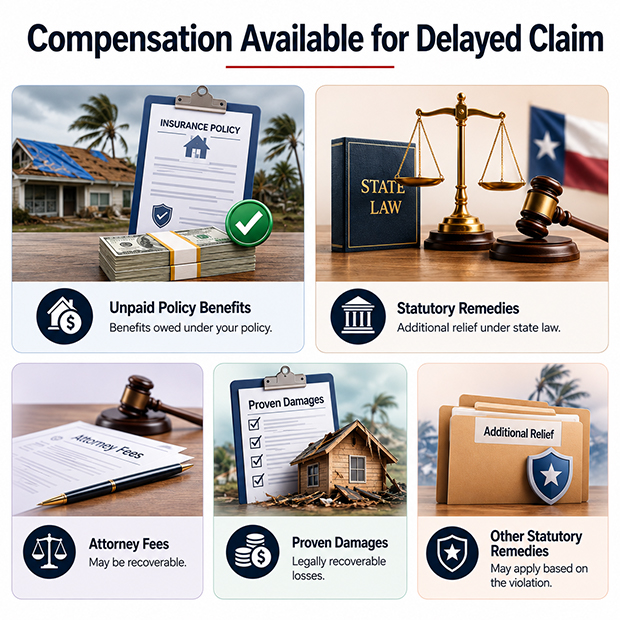
If an insurer improperly delays a hurricane insurance claim, the remedies available depend on the policy, the facts of the claim, and whether Louisiana or Texas law applies. “Depending on the circumstances and applicable law, available remedies may include:
- Unpaid Policy Benefits: You may be able to pursue benefits owed under the terms of the insurance policy if covered damage remains unpaid.
- Statutory Remedies: State law may provide additional remedies when an insurer violates applicable claim-handling or prompt-payment requirements.
- Attorney Fees: Depending on the applicable statute and circumstances, attorney fees may be recoverable.
- Proven Damages: Documented losses that are legally recoverable may be available in some circumstances.
- Other Statutory Remedies: Additional relief may apply depending on the type of violation and the governing law.
These remedies are not automatic simply because a claim has been delayed. A property damage attorney can review the claim history, policy, and applicable law to determine which remedies may be available in your situation.
Common Mistakes Homeowners Make When Their Hurricane Claim Is Delayed
When an insurer is slow to act, frustration can lead to decisions that make a claim more difficult to evaluate. Avoid these common mistakes:
- Waiting indefinitely for an inspection, decision, or payment without following up
- Relying only on phone calls instead of maintaining written claim communications
- Failing to document conversations, including dates, names, and important statements
- Losing photographs or videos that show the property’s condition after the hurricane
- Making permanent repairs before adequately documenting the damage
- Failing to check how an information request affects the applicable claim deadlines
- Signing a release without understanding its legal consequences
- Assuming appraisal resolves a coverage dispute, when appraisal generally focuses on the amount of loss
- Waiting until a limitations deadline approaches before seeking legal guidance
- Sending a demand or statutory notice without understanding the requirements that apply to the specific claim
Keeping organized records and getting legal guidance when problems arise can help you avoid these pitfalls and make informed decisions about your delayed claim.
How a Hurricane Insurance Claim Lawyer Can Help With a Delayed Claim
A hurricane insurance claim lawyer can look beyond the delay itself to determine whether the insurer’s handling of the claim complies with the policy and applicable Louisiana or Texas law. That review may involve the claim history, coverage and causation issues, applicable deadlines, and the insurer’s communications and decisions.
If the claim raises concerns about bad faith, underpayment, or wrongful denial, an attorney can assess whether the available facts support further action. Depending on the circumstances, the attorney may also prepare an appropriate statutory notice or demand and determine whether appraisal, mediation, or another dispute-resolution process makes sense. If litigation becomes appropriate, the attorney can evaluate the potential claims and legal strategy based on the policy, evidence, and applicable Louisiana or Texas law.
Having an attorney review a delayed claim can help you understand where the claim stands and which options may be appropriate for moving forward.
Conclusion
A delayed hurricane insurance claim does not mean you have to wait indefinitely for answers. Document your communications, inspections, requested information, and claim decisions, then review the policy and applicable deadlines.
Louisiana and Texas have different rules governing claim handling, payment, and potential bad-faith conduct, so the appropriate response depends on where your property is located and the circumstances of your claim. Before sending a formal demand or statutory notice, consider seeking guidance from an experienced property damage attorney.
If your claim has been delayed, denied, or underpaid, Pandit Law can review your situation and help you understand your legal options.